The course, Corporate Integrity for Sustainable Success is a comprehensive, intensive and interactive program designed to give your organisation a leap in performance.
What is it?Course subjects range from the basic principles of organisational success and identifying your organisation's guiding purpose and values, through to the types of mechanisms needed to implement and maintain these principles. These The training is followed up with Organisational Coaching to ensure it is fully effective. |
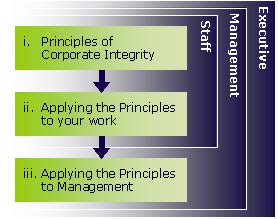
Who is it for?The course is focused on board, executive and management personnel, but is much more effective if all staff are trained in the principles. Different streams within the course address these different audiences. We prefer to link in with your internal training division to provide that broad-based training, and transfer ongoing management of the program as required. |
The course structure
The course is broken into four main parts:
- Clarifying your organisation's core purpose and values.
- Understanding the principles that underpin any organisation's success.
- How to make the principles work for you and your organisation.
- Using the principles to create successful strategies, goals and ways of achieving them.
[Jump to: Top]
Course content
The course is based on mycore principles . This section fleshes out the main parts of the course.1. Your Corporate Purpose and Values
It is important to start the course by clarifying and defining the core Purpose and Values that drive your organisation. This is not about declaring what they 'should be' as defined by current trends; this is about getting to the core of why your organisation exists and how it prefers to execute that purpose.
Knowing this is essential: everything your organisation does is driven by your purpose and guided by your values. If these are unclear, anything anyone does inside and outside of your business will depend on guesswork, ego and repetition.2. The Principles of Corporate Integrity
The principles are a blueprint for business alignment: they set out what constitutes any organisation, and how those constituent parts interact best to achieve the organisation's goals and purpose. They cover interactions between people, eliminating wastefulness, setting and measuring for success criteria.3. Applying the Principles to your work
Now the fundamental principles are clear, this part coaches participants in how these principles translate to workplace practices. It includes:Exercises throughout the course have participants apply what they learn to their organisation, division, and job.
- Maintaining motivation for the job (managing expectations through communication, negotiation, and enforcement)
- Allowing and encouraging excellence (opportunities and rewards for exceeding expectations, social responsibility)
- Being unwasteful (eliminating wastefulness, whole-system optimisation, and service-flow vs. batch-store-deliver models)
- Recognising and measuring success (different metrics, ways of measuring and what to do with the results)
- Defining your divisional purpose (Management stream)
4. Applying the Principles to Management
This part coaches participants in how these principles translate into management practices. Particularly:
- Developing consistent and relevant strategies, goals, policies, processes, systems
- Taking advantage of Lean thinking*, service and flow production models
- Implementing Triple Bottom Line considerations
- Human resources and services
- Leadership development and the importance of succession management
- The quest for improvement
*Lean thinking is a service mark of the Lean Thinking Insitute.
Cost
Course costs are dependent on the number of people there are to train. Although I don't have a per person cost, I do have class size limits. The course is also available by itself, separate to the whole program.
Interesting? Then read more about the coaching, or contact me to arrange for one of my staff talk to you about how this program might work in your organisation.